
The RADAR Method — for families and caregivers
See the storm coming.
Stay steady.
Repair in the calm.
A steady method for hard weather, made for caregivers of children, teens, and adults. Five steps you can practice, a shared language for the weather you’re in, and a way back to each other after the storm.
A practiced way through changing weather
Hard moments ask a lot of you. They can arrive on a weekday morning, at a day program, or late at night, whether the person you care for is six, sixteen, or thirty-six. The RADAR Method gives you a clear sequence to follow: settle yourself and connect, notice what is coming and adjust, lead through the storm, keep everyone safe, and repair once it has passed.
It is not about controlling your child, teen, or adult family member. It is not a quick fix, and it is not therapy. It is caregiver education — practical steps, a shared language, and tools you can adapt to your person and your life.
The RADAR Method
Five steps, from the first sign of weather to the calm after
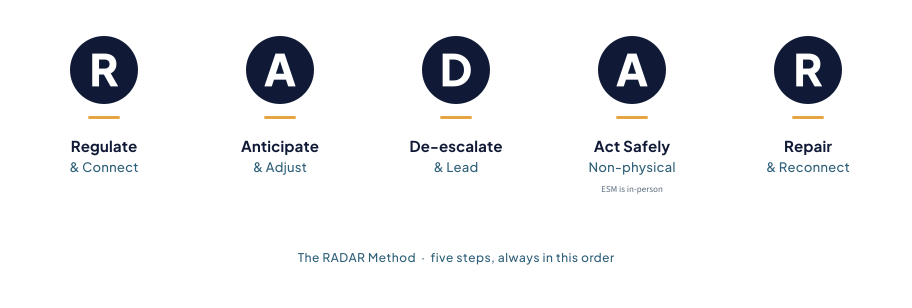
R · Regulate & Connect
Start with your own nervous system — your breathing, tone, and posture. Then notice how your person is doing, and connect with a calm voice, a simple check-in, or eye contact if it is comfortable. Your steadiness and your connection make safety possible.
A · Anticipate & Adjust
Look ahead to what might be hard — a transition, an appointment, a crowded room — and put supports in place. When you see early warning signs, adjust the environment, the schedule, or the demand.
D · De-escalate & Lead
Listen for the need under the behavior, then guide your person back toward calm with fewer words, real choices, and a steady voice. You can set a limit and still be respectful of their age, rights, and autonomy.
A · Act Safely
When a moment becomes a crisis, safety comes first. Give space, move other people and dangerous objects out of the way, keep your words brief, and decide whether to call for help. Act Safely is non-physical. In-person safety skills are taught separately, if you choose that optional add-on.
R · Repair & Reconnect
After the storm, reconnect first, then repair. Model the skills you want your person to learn — apologizing, taking a break, asking for help, trying again — and plan for next time with their voice included whenever you can.

A shared language for the weather you’re in
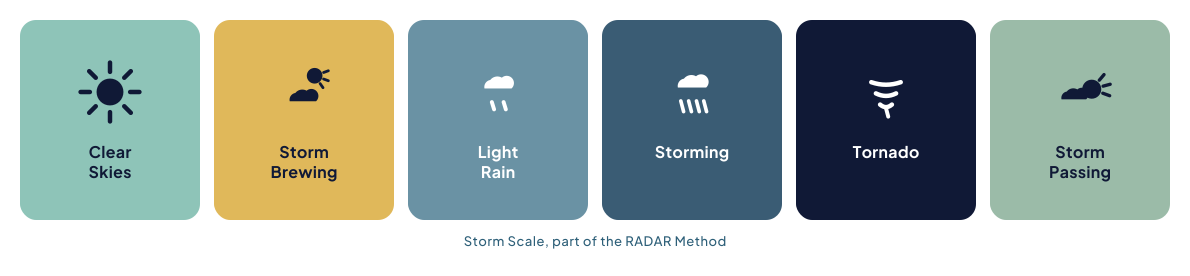
RADAR is the method. The Storm Scale is the gauge inside it. Instead of only asking “How do I stop this?”, you learn to ask “What storm level are we in right now?” The six levels run from Clear Skies to Storm Passing. Most of us react when things are already loud. The work is learning to notice sooner, at Storm Brewing, while there is still room to adjust.
Built for the people who weather it together
The RADAR Method is for parents, guardians, family members, and other caregivers supporting a child, a teenager, or an adult. You do not need a formal diagnosis to use it. If someone’s behavior sometimes feels bigger than the tools you have right now, this is for you.
It is also for the professionals who stand beside those families — educators, school teams, and agency staff — who want a shared language they can use with caregivers, not a clinical protocol.
Caregivers of children and teens
A method you can practice at home, after school, and in the moments that catch you off guard.
Caregivers of adults
The same five steps, with respect for your person’s age, rights, and autonomy.
Teams and organizations
A training path for schools, agencies, and community groups who want a steady framework to share.
The RADAR app, when you need a reading of the sky
The RADAR app is an AI behavior coach — an everyday companion to the method, designed to help you know where you are and what to do next. It is coming soon.
Join the waitlist
Tell us a little about you, and we’ll write when the next caregiver course, group training, or app update is ready. No diagnosis, and no need to share someone else’s story.
Because the weather shouldn’t leave you guessing.
You already know your person better than anyone else. The RADAR Method adds structure, language, and tools to the care you are already giving.